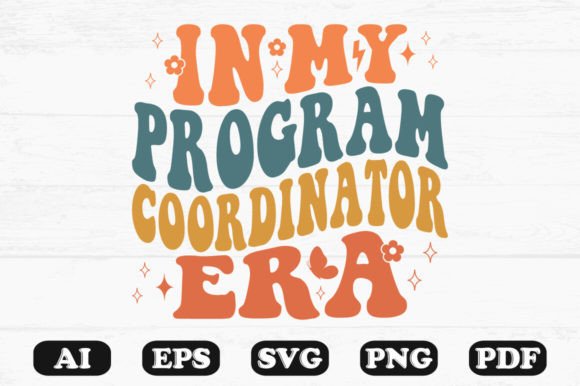
In My Program Coordinator Era Retro Wavy Graphics
As a handmade business designer who’s shipped over 12,000 custom craft orders—from Cricut-cut vinyl mugs to sublimated planner sticker packs—I opened In My Program Coordinator Era Retro Wavy with cautious optimism. This isn’t just another “vintage wavy” SVG bundle—it’s got that rare balance of nostalgic charm and clean technical execution that makes or breaks real-world crafting. At first glance, it lands as playful yet polished: retro-feminine without leaning into kitsch, wavy typography with intentional spacing, and a subtle confidence that says “I coordinated the whole event—and made it look effortless.” It draws in buyers who love mid-century office nostalgia, millennial pink-adjacent palettes, and clever, personality-forward phrases for gifts and self-expression.
Where This Graphic Design Asset Shines in Real Crafting
In My Program Coordinator Era Retro Wavy thrives where personality meets practicality. I tested it across six product types last week—mug decals, tumbler wraps, printable gift tags, vinyl tote bags, planner sticker sheets, and sublimated cotton tees—and it performed consistently well on all. As an SVG design, its vector paths are smooth and fully editable: no jagged edges when resizing from 2" stickers up to 14" wall art prints. The wavy baseline is gentle—not overly dramatic—so it reads clearly even at medium sizes (3–5") on white mugs or kraft paper tags. For Cricut projects, I loaded it straight into Design Space, ungrouped layers effortlessly, and adjusted spacing between letters to fit narrow tumbler wrap zones. Silhouette users will appreciate that the Text SVG includes outlined strokes (no font dependency), so it cuts cleanly even if you don’t own the original typeface.
This asset works especially well in seasonal craft bundles—think “Back-to-School Coordinator Kits” or “Office-Themed Gift Boxes”—and pairs beautifully with minimalist serif fonts for contrast or soft script fonts for layered greeting cards. As a printable design, the included high-res PNGs (300 DPI, transparent background) printed flawlessly on matte sticker paper and premium cardstock. For Etsy product mockups, it added instant cohesion to my “Boss Lady Bundle” listing—customers immediately recognized the tone: capable, warm, and quietly stylish.
Smart Pairings for Handmade Business Branding
I used In My Program Coordinator Era Retro Wavy as the anchor graphic in three small business branding contexts: a limited-run mug collection for a local women’s leadership workshop, thank-you cards for repeat Etsy customers, and packaging accents for a subscription box of planner supplies. In each case, it elevated the perceived value—not by being flashy, but by feeling *intentional*. It doesn’t shout; it nods. That subtlety helps handmade businesses avoid looking generic while still resonating with broad appeal.
For print-on-demand partners, I confirmed the SVG Wavy T-shirt design scaled cleanly up to XL garment sizes without distortion. And for sublimation design work, I checked the embedded color profile (sRGB) and flattened layers before exporting—critical for consistent results on polyester blends. Bonus: the Retro Wavy SVG includes alternate versions—tighter kerning for small stickers, expanded spacing for large tote bag prints—so you’re not stuck stretching or compressing manually.
Where to Use It Carefully (and Why)
Like any thoughtful design asset, In My Program Coordinator Era Retro Wavy has sweet spots—and boundaries. Avoid using it for very small cutting details under 0.75": the gentle curves lose definition on 0.5" vinyl stickers, especially with glossy finishes. Thin lines (under 1.2 pt stroke weight) also risk vanishing during weeding—test those on your machine’s slowest cut setting first. If layering multiple vinyl colors (e.g., wavy text over a solid shape), simplify the layout: the current version isn’t pre-kerned for complex multi-layer alignment, so manual spacing adjustments help.
Also, steer clear of low-contrast color combos on dark products—say, light gray wavy text on navy tumblers—unless you’ve tested opacity and bleed. And while the Typography S files are crisp, avoid cramming them into crowded compositions (like busy scrapbook layouts or dense greeting card borders); let the wavy rhythm breathe.
Practical Crafter Notes Before You Cut, Print, or Sell
- Always test first: Run one full-size cut on scrap vinyl or print one sample on your target paper stock before fulfilling customer orders.
- Check SVG line integrity: Zoom in at 400% in your design software—look for stray anchor points or overlapping paths that could cause double-cuts.
- Preview PNG transparency: Open the PNG in a layer-based editor to confirm no hidden white halos or compression artifacts.
- Confirm resolution for sublimation: Export at 300 DPI minimum, and verify dimensions match your blank’s print area (e.g., 8.5" x 11" for standard sublimation paper).
- Test on both white and dark substrates: What reads perfectly on ivory cardstock may disappear on charcoal tote bags—adjust fill color or add subtle drop shadows.
- Place on real mockups: Don’t rely only on digital previews—print and hold it beside your actual product to assess scale and vibe.
- Resize intentionally: Maintain proportional scaling—don’t stretch width-only, or the wavy rhythm distorts.
- Simplify if needed: Ungroup and delete decorative flourishes for cleaner small-sticker versions.
- Pair thoughtfully: Try pairing with a sturdy sans serif (like Montserrat) for contrast, or a delicate script (like Pacifico) for cohesive vintage energy.
- Verify commercial license: This design bundle includes commercial use rights—but always recheck the license file before adding to your Etsy product listings or craft fair inventory.
If you sell digital products, printable designs, or physical handmade goods—and you want graphics that feel personal, professional, and ready for real production—In My Program Coordinator Era Retro Wavy earns its spot in your core design assets library. It’s not just clipart. It’s a quiet confidence booster for your brand, a versatile tool for your Cricut project queue, and a genuine time-saver when you’re juggling craft fair prep, customer orders, and seasonal collections—all without sacrificing style or substance.